Reasoning
Choose an approach
Symbolic, knowledge-graph, case-based, hypothesis, and analogical reasoning are coordinated through a hybrid reasoning tool.
Tyc / Conversational marketplace / Mongolia
 TycVisit the product ↗
Connecting people who need help, independent gig workers, and local businesses—with Bolor chat as a shared entry point for finding work and getting things done.
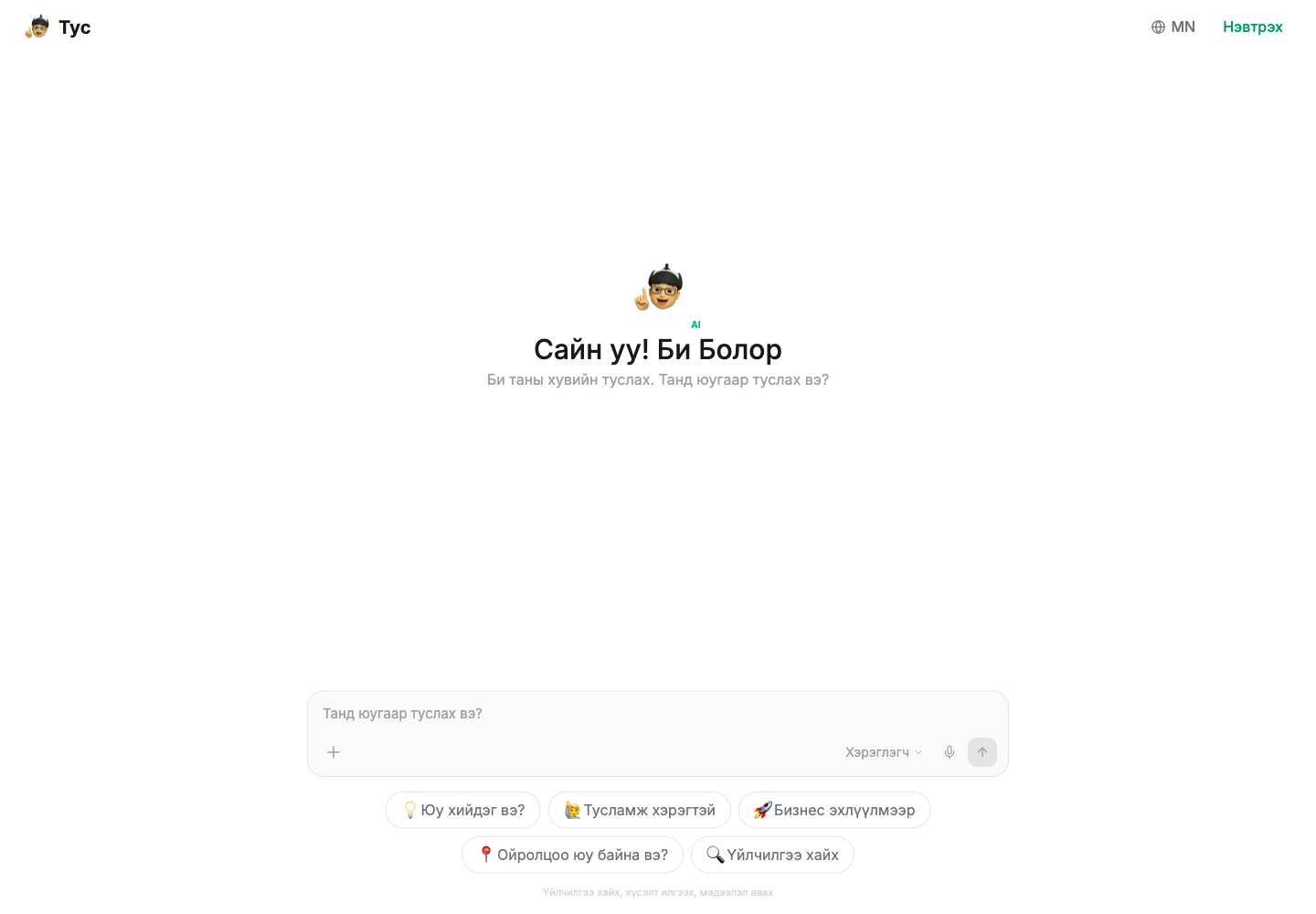
01 / The challenge
A customer may need a cleaner. An independent worker may be looking for a short job. A service business needs to fill its schedule and manage the customers it already has.
Tyc connects these needs within one ecosystem. The design challenge is to make the next task understandable without asking people to learn every part of that ecosystem first.
The central interaction: express an intention in chat, review a structured result, then take the next action.
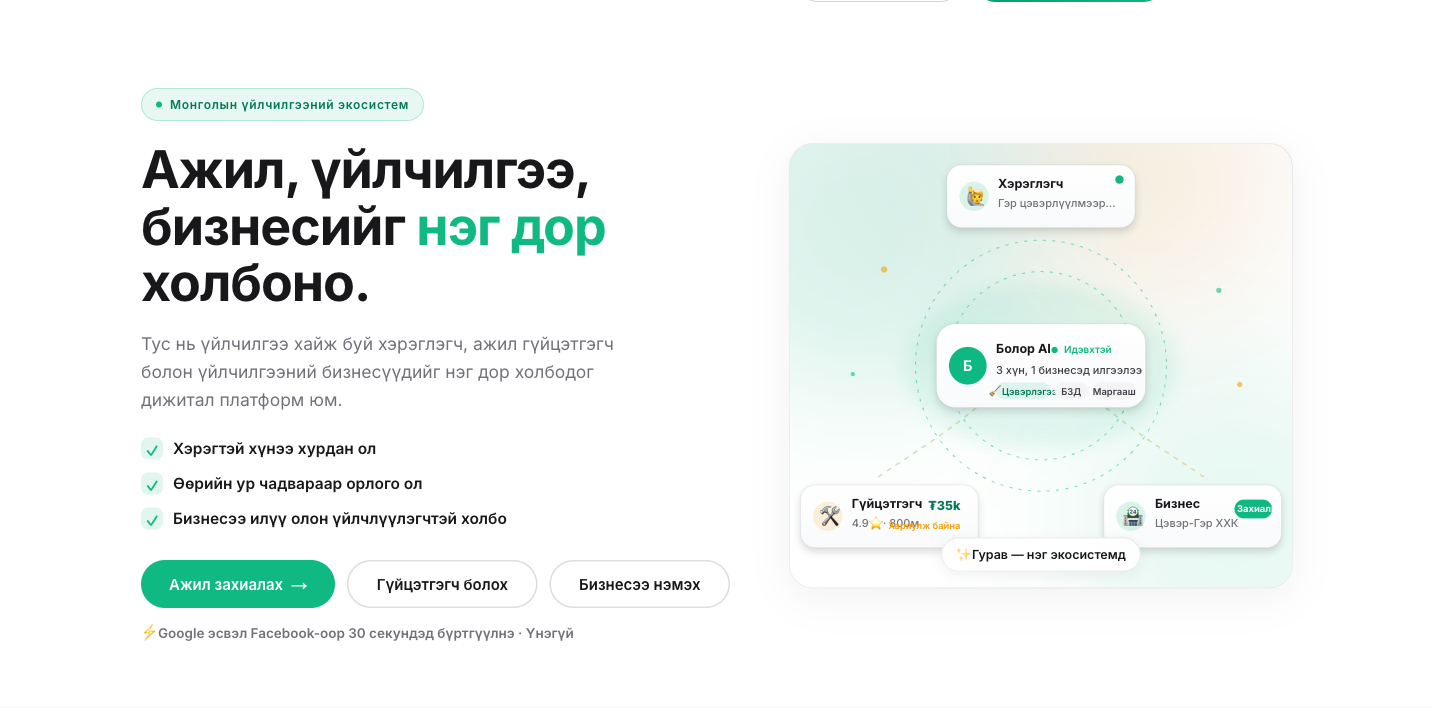
02 / Three perspectives
Explore the customer, worker, and business paths. Each view follows functionality present in the project.
Customer
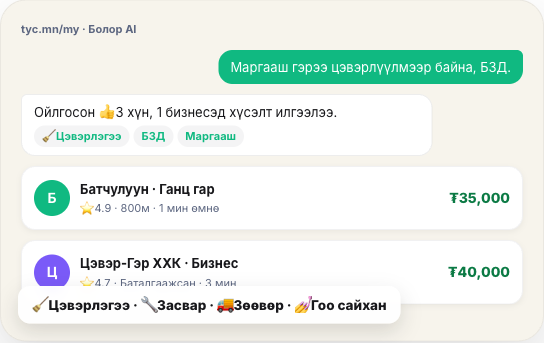
A request gathers the service, location, budget, and timing. People can compare replies from an individual or a business before continuing the conversation.
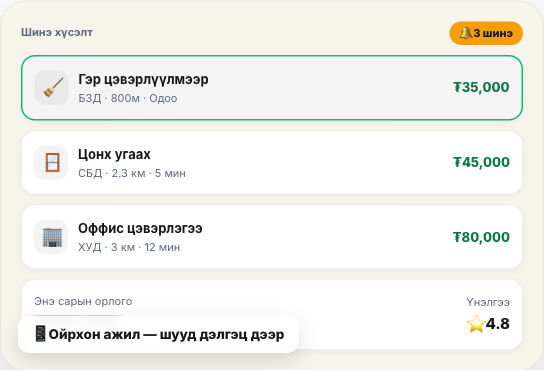
Independent worker
The current gig cockpit lists available service requests, opens a conversation when a provider expresses interest, and updates from request notifications.
Local business
A business can participate in the marketplace and manage its services, clients, and bookings. Bolor exposes business actions when the account has business context.
My own conversational tooling
I used my own Bolor Brain MCP server for the conversational work behind Tyc. Building the supporting AI tooling was part of my contribution, alongside shaping the marketplace experience.
Bolor Brain provides structured reasoning, persistent memory, and learning from previous problem–solution cases. Its public implementation includes several reasoning approaches and tools for storing and recalling knowledge.
Tyc’s application layer carries out marketplace actions and returns their results as cards in the conversation. This keeps reasoning, product actions, and the user’s confirmation steps distinct.
Explore my Bolor Brain MCP on GitHub ↗Reasoning
Symbolic, knowledge-graph, case-based, hypothesis, and analogical reasoning are coordinated through a hybrid reasoning tool.
Memory
Store and recall facts, cases, and relationships through the server’s memory tools.
Learning
Save a problem, its solution, and its outcome so future reasoning can draw on previous work.
03 / From words to action
Free-form input is flexible. Structured cards give people something concrete to inspect, compare, and confirm.
The service-request flow saves a draft before publication. Category, location, budget, and timing become visible fields, giving the conversation a concrete object to work with.
Confirmation checks that the draft belongs to the current person and is still a draft. A phone number is required before publication; the interface points to settings if it is missing.
Provider matching uses service category and location, with ratings and distance contributing to ranking when available. Both independent providers and businesses can appear.
Accepting a response creates or retrieves a conversation associated with that request. The customer and provider can continue discussing the same work.
Keeping context
Bolor’s assistant conversation and the customer–provider message thread serve different purposes. The assistant helps navigate and act; direct messaging lets the people doing the work settle the details.
The current gig feed starts a conversation when a provider expresses interest. Accepted responses in the service-request flow also retain the request link. The diagram below summarizes this implemented handoff.
Service, location, budget
Independent worker or business
The request stays attached
Flow diagram based on the current application code.
04 / Business operations
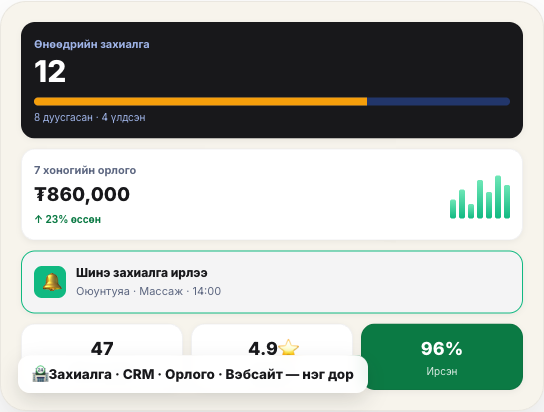
Business accounts need more than incoming leads. Tyc’s chat tools cover bookings, clients, services, revenue, and business settings, while dedicated screens provide an overview.
Setup follows a guided conversation with focused inputs for business type, name, services, prices, and opening hours. Structured widgets keep these details reviewable.
Context
Chat distinguishes customer actions from business actions using the signed-in account’s business context.
Local relevance
Mongolian interface copy, tögrög pricing, and location-aware discovery make the marketplace specific to its audience.
Continuity
Tool results appear as cards inside the conversation, connecting the user’s request to the resulting product state.
05 / What comes next
Tyc has a public website and a codebase covering conversational requests, provider matching, direct messaging, guided setup, and business management. This case study traces those implemented flows.
Can people correct a misunderstood request? Do provider comparisons support confident choices? Does the handoff preserve enough context to reach an agreement? These are the next usability questions—not measured results.
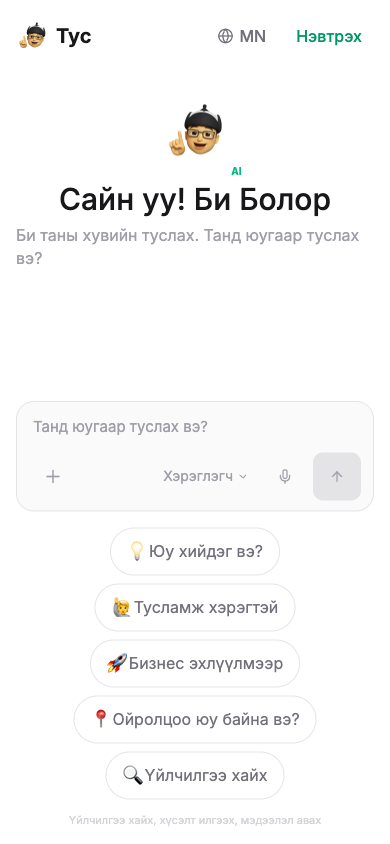
Visuals were captured from the current Tyc website on October 7, 2026 and checked against its source components. Chat captures show the public entry state. Marketplace and business illustrations come from the live landing page and contain illustrative records, not authenticated account data. This case study does not claim measured adoption, conversion, or revenue impact.